
How to compare two areas before deciding where to buy
A practical, repeatable way to compare two areas side by side using the same signals, official data, clear scoring, and on‑the‑ground checks. Focus on affordability, access, safety, education, environment and risk, amenities, and digital connectivity, then weight results to your priorities before visiting to verify.
Overview
Choosing between two areas is far easier when you use the same signals, drawn from authoritative sources, scored on a common 0 to 100 scale, then checked in the field. This guide gives you a complete, reusable workflow so you can compare areas side by side on affordability, access, safety, education, environment and risk, amenities, and digital connectivity.
Start by fixing what is comparable. Use the same small‑area geography across datasets, the same property type and budget, and note the time period for each dataset. Pull each signal from an official source with clear methods, normalise to a 0 to 100 scale, apply sensible weights, and run basic checks for gaps or anomalies.
Finish with real‑world verification. Visit both areas at different times, replicate your key journeys, review local plans and upcoming transport schemes, and apply red lines such as unacceptable flood risk or no realistic broadband option above your threshold.
Key definitions and comparators
Step by step walkthrough
Weighting, trade offs and decision rules
Start with equal weights across the seven signal groups and adjust to match your stated priorities. Use a capped scheme so no single category exceeds 30 per cent of the total. Document your weights before you score to avoid bias.
Apply tie‑breaking rules in order. First, exclude any area that breaches your red lines. Second, if still tied, choose the area that scores higher on your top priority category. Third, if still tied, prefer the area with lower volatility metrics such as fewer indicators based on small samples.
Worked examples
Assumptions used below: MSOA boundary; existing 3‑bed semi‑detached, £450,000 budget; 0 to 100 scales with higher better; equal weights unless stated. Dates: affordability 2025 annual, access using the latest Journey Time Statistics, safety last 12 months, education 2024 to 2025 KS4 and latest inspection, environment risk 2025 NaFRA2 with 2025 PM2.5 background, amenities from Journey Time Statistics, and connectivity from Connected Nations 2024 to 2025.
Raw inputs. Affordability price to income ratio: S1 7.5, S2 6.5. Access to employment centre by public transport: S1 38 minutes, S2 55 minutes. Safety crimes per 1,000 residents aggregated to MSOA: S1 62, S2 48. Education nearest secondary KS4 Attainment 8: S1 50.5, S2 47.0. Inspection components indicate curriculum and safeguarding strong for both. Environment and risk: dwellings in medium or higher fluvial or coastal risk S1 3 per cent, S2 0 per cent. PM2.5 background S1 9.5, S2 8.0 micrograms per cubic metre. Amenities travel time to food store: S1 8 minutes, S2 12 minutes. Digital: gigabit availability S1 92 per cent, S2 70 per cent; indoor 4G on at least two networks S1 yes, S2 borderline in pockets.
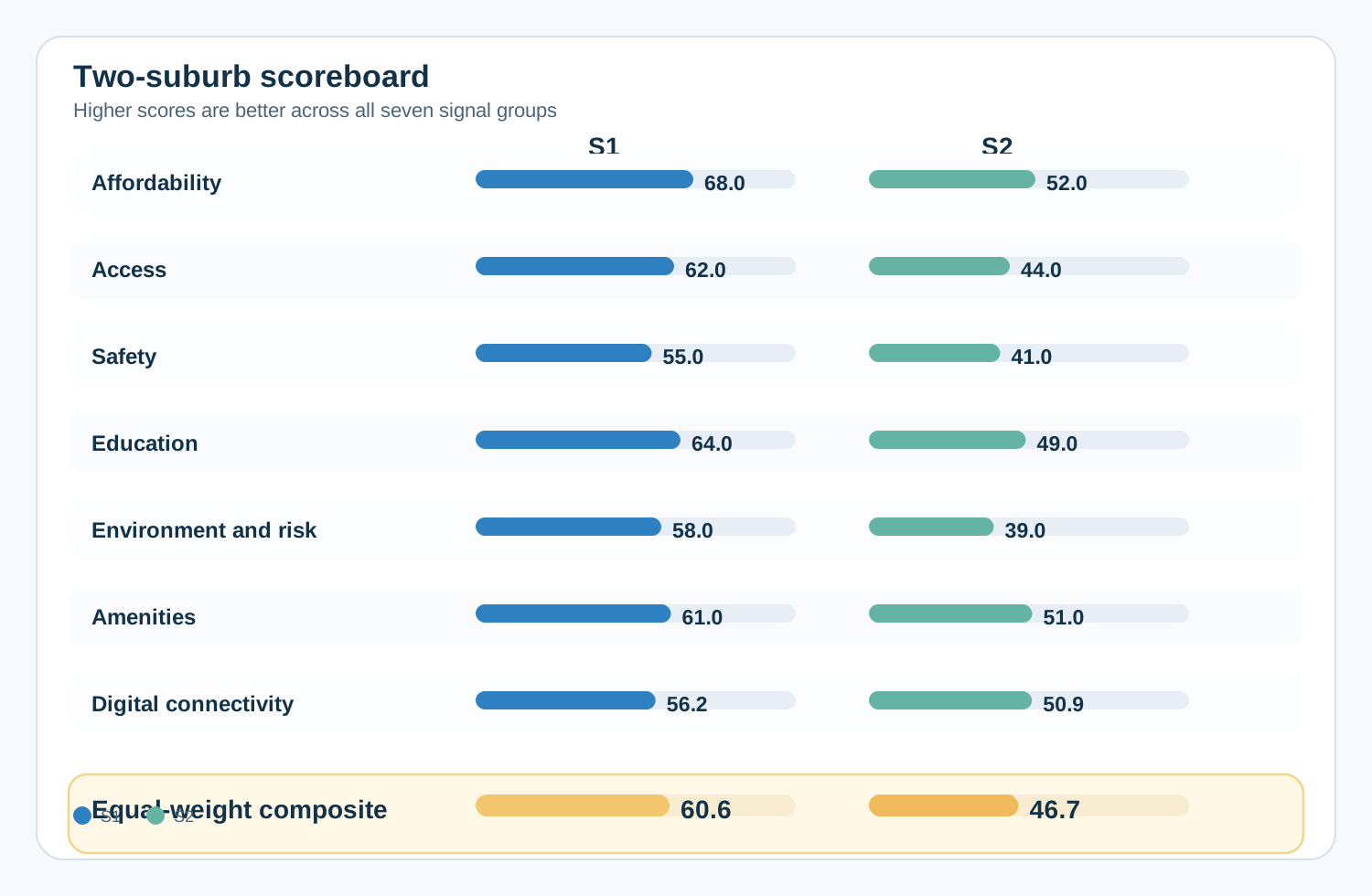
Scoring. Affordability target scale 3.0 gives 100 and 12.0 gives 0, so S1 39 and S2 50. Access min‑max between the two: 38 minutes is 100 and 55 minutes is 0, so S1 100 and S2 0. Safety min‑max lower is better, so S1 0 and S2 100. Education target scale with Attainment 8 of 55 giving 100 and 40 giving 0 yields S1 70 and S2 47. Environment and risk: flood proportion 0 per cent gives 100 and 5 per cent gives 0, so S1 40 and S2 100; PM2.5 min‑max gives S1 0 and S2 100; average these two for an environment subscore of S1 20 and S2 100. Amenities 8 minutes gives 100 and 12 minutes gives 0, so S1 100 and S2 0. Digital scales gigabit 60 per cent to 0 and 95 per cent to 100, then averages with a 4G reliability flag, giving S1 95 and S2 30.
Equal weights across the seven categories give a composite of S1 60.6 and S2 46.7. Interpretation: S1 leads on access, education, amenities and connectivity, while S2 leads on safety and environment. If flood exposure is a red line, S2 may still be preferable. If commute time is critical, S1 is robust.
| Measure | Basis | Score |
|---|---|---|
| S1 affordability score | S1 39 versus S2 50 (assumption) | 39 |
| S1 access score | S1 100 versus S2 0 (assumption) | 100 |
| S1 safety score | S1 0 versus S2 100 (assumption) | 0 |
| S1 education score | S1 70 versus S2 47 (assumption) | 70 |
| S1 environment score | S1 20 versus S2 100 (assumption) | 20 |
| S1 amenities score | S1 100 versus S2 0 (assumption) | 100 |
| S1 digital score | S1 95 versus S2 30 (assumption) | 95 |
| S1 composite | Equal-weight result (assumption) | 60.6 |
| S2 composite | Equal-weight result (assumption) | 46.7 |
| Composite gap | S1 lead over S2 (assumption) | 13.9 |
| S1 composite score | 60.6 | |
Raw inputs. Affordability ratio: city fringe C1 9.0, coastal C2 5.8. Access to hospital by public transport: C1 28 minutes, C2 42 minutes. Safety crimes per 1,000: C1 74, C2 52. Education KS4 Attainment 8: C1 49.0, C2 45.0. Inspection components show both with effective leadership, with C2 improving quality of education. Environment and risk: flood risk dwellings C1 0 per cent, C2 6 per cent coastal risk indicated; PM2.5 C1 10.5 and C2 7.5 micrograms per cubic metre. Amenities time to food store: C1 6 minutes, C2 10 minutes. Digital: gigabit C1 98 per cent, C2 82 per cent; indoor 4G on two networks yes for both.
Weights adjusted to emphasise affordability and environment and risk: Affordability 30, Access 10, Safety 10, Education 10, Environment and risk 25, Amenities 10, Digital 5. Target and relative scales then give a weighted result of C1 58 and C2 62.
Decision aid. If flood risk is a red line, C2 fails and C1 is the safer choice. If the plan is to buy below £400,000 and prioritise cleaner air and lower prices, C2 wins subject to a site‑specific flood assessment and an insurance check.
| Measure | Basis | Value |
|---|---|---|
| City-fringe weighted score | C1 result (assumption) | 58 |
| Coastal weighted score | C2 result (assumption) | 62 |
| Score advantage | C2 lead over C1 (assumption) | 4 |
| City-fringe flood exposure | Dwellings in stated risk category, percent (assumption) | 0% |
| Coastal flood exposure | Dwellings in stated risk category, percent (assumption) | 6% |
| City-fringe PM2.5 | Micrograms per cubic metre (assumption) | 10.5 µg/m³ |
| Coastal PM2.5 | Micrograms per cubic metre (assumption) | 7.5 µg/m³ |
| Coastal weighted score | 62 | |
Checklists you can print
Use these two short checklists to structure your work and avoid missing steps.
Pre‑comparison setup
Decision and validation
Glossary
- LSOA, MSOA
Small statistical areas designed by ONS for consistent local analysis and widely used across official datasets in England and Wales.
- UK HPI
The official UK House Price Index using Land Registry and partner data, published monthly with revisions.
- Price Paid Data
HM Land Registry’s open dataset of individual residential sales in England and Wales since 1995, refreshed monthly.
- Housing affordability ratio
ONS median house price divided by median earnings, available as workplace‑ or residence‑based.
- JTS
Department for Transport Journey Time Statistics to key services, published at local authority and LSOA levels.
- Police.uk open data
Street‑level crime data with anonymised locations. Pins are not exact addresses and some incidents are withheld.
- Ofsted report cards and DfE performance
Official inspection component judgements and attainment measures such as Attainment 8 and Progress 8.
- NaFRA2
Environment Agency’s updated national flood risk assessment informing long‑term flood risk maps.
- PCM model
Defra’s Pollution Climate Mapping model producing 1 km background air‑quality maps for pollutants such as PM2.5.
- Connected Nations and Map Your Mobile
Ofcom’s official reporting and methodology for fixed broadband coverage and modelled mobile availability.
Verified callouts
Verified: median price and price to income ratio
The UK House Price Index publishes local authority‑level prices and breakdowns by property type, based on registered sales and subject to revisions. ONS calculates affordability ratios annually using median house prices and ASHE earnings, with workplace‑ and residence‑based variants and documented quality limits.
Verified: school inspection and performance data usage
England’s inspectorate now reports component judgements rather than a single overall grade. Compare those components with DfE attainment metrics such as Attainment 8 and Progress 8 from Explore Education Statistics, and always read the latest KS4 methodology notes when comparing years.
Verified: crime rate definitions and area boundaries
Police.uk street‑level crime locations are anonymised to the nearest map point and some incidents are withheld. Aggregate to consistent small areas before calculating rates. For official comparisons, the Home Office user guide recommends using stable geographies such as Community Safety Partnerships or police force areas with appropriate denominators.
Related definitions to read next
Definitions
- Statistical geographies in England and Wales, with examples of LSOA and MSOA
- UK House Price Index versus Price Paid Data and HPSSA
- Housing affordability ratios, workplace‑ vs residence‑based
- DfT Journey Time Statistics, key service definitions, and example use
- Police.uk data structure, anonymisation and safe aggregation
- Ofsted report cards and how to read DfE performance measures
- Environment Agency flood data, NaFRA2 and Flood Zones for planning
- Defra UK‑AIR background maps and how to use modelled 1 km data
- Ofcom Connected Nations and Map Your Mobile methodology overview
Sources
- Census 2021 geographies overview
- Journey Time Statistics: data tables (JTS)
- About the UK House Price Index
- About the Price Paid Data
- Housing affordability in England and Wales QMI
- Street‑level crime methodology
- About Police.uk crime data
- Understanding Ofsted report cards and grades
- Key Stage 4 performance methodology
- Updates to national flood and coastal erosion risk information
- UK‑AIR Pollution Climate Mapping data
- Access to green space in England
- Connected Nations FAQs
- Map Your Mobile threshold methodology 2025
- Create or update a local plan
Join the discussion
Spotted something wrong, or want to add to this? Comments are reviewed before they appear.
Comments are reviewed before they appear. Community rules
-
When two areas look equally good on paper, the final decision often comes down to one very personal detail. What was the deciding factor the last time you chose one area over another?